
Checking a Used Miner at Handover With a Phone in Your Hand
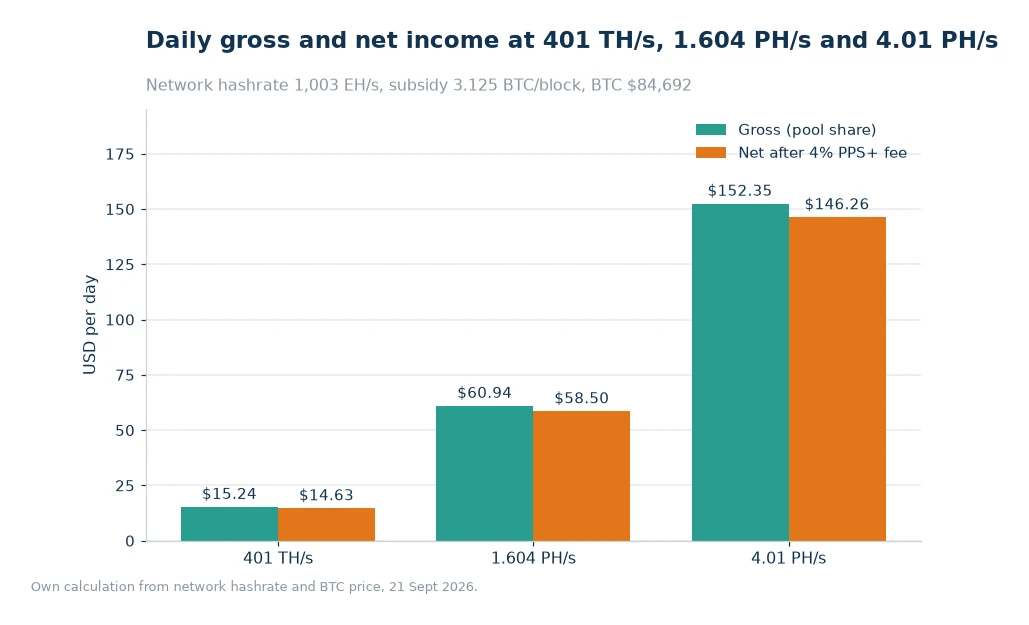
A used ASIC is bought on a driveway, not in a showroom, and the seller's claim about hashrate is worth exactly what you can verify before the cash changes hands. At 401 TH/s the machine should produce about 0.00017989 BTC a day, or $15.24 gross at $84,692, and $14.63 after the listed 4% on the block-reward component. A unit that reads 15% low on the spot is a different purchase at the same price.
Key takeaways
- 401 TH/s is 0.00017989 BTC a day, so a 10% shortfall costs about $1.52 daily at the reference price.
- Ask for the machine to be hashing on a pool account you can see before you arrive.
- Twenty minutes of shares is enough to catch a dead board, not enough to grade a unit.
- Record the serial, the firmware version and the pool screenshot in one album before paying.
What a driveway inspection can and cannot show
You can see whether the fans spin, whether the case has been opened, and whether the PSU is the original. You can hear a bearing that is on its way out and smell a board that has been running hot. None of that tells you the hashrate, and hashrate is the only thing you are actually buying.
The number that matters is accepted shares over time, measured by a pool rather than by the seller's dashboard. A miner's local interface reports what the machine thinks it is doing; a pool reports what it has actually been credited for. Those two figures usually agree, and when they do not, the pool is right.
That is why the phone matters. If the machine is already pointed at an account you can log into, the handover becomes a live test rather than a conversation. You are not trusting a claim; you are watching a series update while you stand there.
Setting up the account before the meeting
Create the worker name in advance and write down the exact pool URL and port. Ask the seller to point the machine at it an hour before you arrive, or arrive early enough to do it yourself. If the seller resists a live pool reading, treat that as information about the seller rather than about the machine.
Install the app the night before so the login is already cached and the two-factor step is done at home. Nothing derails a handover faster than a verification code that will not arrive in a stranger's kitchen. Check that the app is signed into the account that owns the worker, not a demo account left over from a previous purchase.
Bring a clamp meter if you own one. The app tells you what the machine produces; the meter tells you what it consumes, and the ratio between the two is the figure that decides whether the unit is worth its rack space. A machine that hits its rated hashrate at 20% above rated power is worse than one that hits 95% at nameplate.
Twenty minutes of shares, read carefully
Pool hashrate is a rolling estimate, so the first minutes after a machine starts are noise. Give it ten minutes to settle, then read three things: the reported hashrate against the rating, the count of accepted shares, and the number of rejected shares. A rejection rate above a couple of percent is usually a configuration problem, but it can also be a failing board.
Compare the reported figure with the arithmetic you did at home. At 401 TH/s the daily credit should be 0.00017989 BTC; over one hour that is 0.00000750 BTC, though hourly credits land in discrete amounts rather than a smooth line. What you are checking at handover is the hashrate, not the balance, because the balance needs a full settlement cycle to be readable.
Watch the hashrate for a full ten minutes without touching anything. A board that is marginal will often run correctly while cold and drift down as it heats. If the figure falls steadily across the sample, the machine is telling you about a thermal problem that a five-minute test would have missed.
| Check | Expected reading | Red flag |
|---|---|---|
| Reported hashrate after 10 minutes | 395 to 401 TH/s | Below 380 TH/s, or still climbing |
| Accepted shares in the first hour | Steady arrival, no long gaps | Gaps over ten minutes |
| Rejected share rate | Under 2% | Above 5%, or rising |
| Daily credit implied | 0.00017989 BTC ($15.24 gross) | Claimed rate that cannot be reproduced |
Worked example
Turn the rating into money before you leave the house, so the negotiation has a number attached to it.
- Fraction of the network held by the unit: 401 ÷ 1,003,107,267 = 3.99758e-7.
- 3.99758e-7 × 450 BTC = 0.00017989 BTC.
- At $84,692: 0.00017989 × 84,692 = $15.24 gross.
- Take the 4% listed on the reward portion away: 15.24 × 0.96 = $14.63.
- A unit reading 361 TH/s, 10% low: 0.00016190 BTC, about $13.71 gross and $13.17 net, or $1.46 a day less.
- Four units at full rating, 1.604 PH/s: 0.00071963 BTC, $60.94 gross and $58.50 net.
- Ten units, 4.01 PH/s: 0.00179910 BTC, $152.35 gross and $146.26 net.
What to photograph before you pay
Take four pictures in a fixed order: the serial label, the PSU label, the pool worker page showing the hashrate, and the share history. The serial protects you if the unit is swapped later; the PSU label tells you whether the power figure was measured with the supply that ships with it; the two screenshots become your baseline for the first week at home.
Also photograph any repair evidence. A replaced fan is fine and often a sign of care; a reflowed board or a jumper wire across a burnt trace is a different conversation. If the seller has a repair invoice, photograph that too. Provenance is not sentiment, it is a discount argument.
Write the agreed price and the measured hashrate on the same note. Six weeks later, when the unit reads 388 TH/s in your own room, you will want to know whether it was 401 on the driveway or 390 and you were optimistic.
The fee schedule is worth reading before the meeting as well, since a clean hashrate reading says nothing about what the listed rates will take out of the coins.
First week at home is part of the inspection
The driveway test grades a moment; the first week grades the machine. Run it at your own ambient temperature and your own pool settings, and compare the weekly average with the handover reading. A small drop is normal as dust settles into the heatsinks and the room warms up. A large one is a warranty conversation, if there is one, and a bench conversation if there is not.
Check the Miner Profitability Ranking for your model during that week. It will show whether the unit is performing near what the model can do at current difficulty and price, which separates a tired machine from a bad market.
Then install the ViaBTC App Download on the phone you will actually carry. The first week is when alerts are calibrated and when a seller's claims are either confirmed or quietly set aside. Log the readings in the same note as the handover figures, and the machine's history starts on day one rather than on the day something goes wrong.
Frequently asked questions
How long should a used miner be tested before buying?
Twenty to thirty minutes of live pool hashrate at the handover catches dead boards and connection faults, but the first week at home is what actually grades the machine.
What hashrate should a 401 TH/s unit show?
Between 395 and 401 TH/s once settled, which corresponds to 0.00017989 BTC a day, or $15.24 gross at $84,692 before the listed 4% is applied.
Is a low rejection rate a sign of a healthy miner?
Usually, but a clean rejection rate only means the shares reach the pool; it says nothing about whether the boards are running at rated speed or at a power draw above nameplate.
Pay on the reading, not on the sticker
Every used machine has a sticker, and most stickers are optimistic. The only defensible price is the one you can reproduce on a pool account you control, at the hashrate the machine actually holds after ten minutes of work. Do that once and the purchase becomes arithmetic instead of a gamble.
Keep the album and the note. They cost nothing, and they turn a later dispute into a comparison of two photographs rather than two memories.
Sources: ViaBTC app and miner ranking pages for monitoring and model comparisons[1]. Published 24 Oct 2026 on readings from 21 Sept 2026: 1,003 EH/s network hashrate, 132.76 T difficulty, 3.125 BTC per block at 144 blocks daily, $84,692 per BTC. Credits assume the unit hashes without interruption.