
Sterling Silver Jewelry Manufacturing Lead Times
Lead time is three windows stacked, and only one of them is the factory's to control. The published figures are a 48-hour CAD turnaround, a 25–30 day sampling window and 3–4 weeks of production for mass production, with an MOQ of 50 pcs per design in 925 sterling silver. Everything else on the calendar is approval time on the buyer's side.
Key takeaways
- CAD under 48 hours, sampling 25–30 days, production 3–4 weeks: the three published windows in order.
- Eight named factory steps run from concept design to delivery, with final inspection at 100% before shipping.
- Published minimums are 100 pcs in eco-brass, 50 pieces in the silver line and 100 plus in stainless, by design, with each design counted separately.
- A 24-hour response time and a dedicated project manager are the two published support commitments.
The three windows and what each one buys
CAD buys a decision: the technical drawing and rendering that fix dimensions before any metal is cut. Sampling buys evidence: a physical piece produced through 3D wax printing, mould casting, stone setting, polishing and electroplating. Production buys quantity: the same design, repeated through the same steps, at 100% inspection.
They cannot overlap in the useful direction. A drawing has to exist before a sample can be cast, and a sample has to be approved before a production batch is scheduled. The one place overlap is possible is preparation — packaging, barcodes and photography can all be arranged while the sample is on the bench.
Where the eight steps sit on the clock
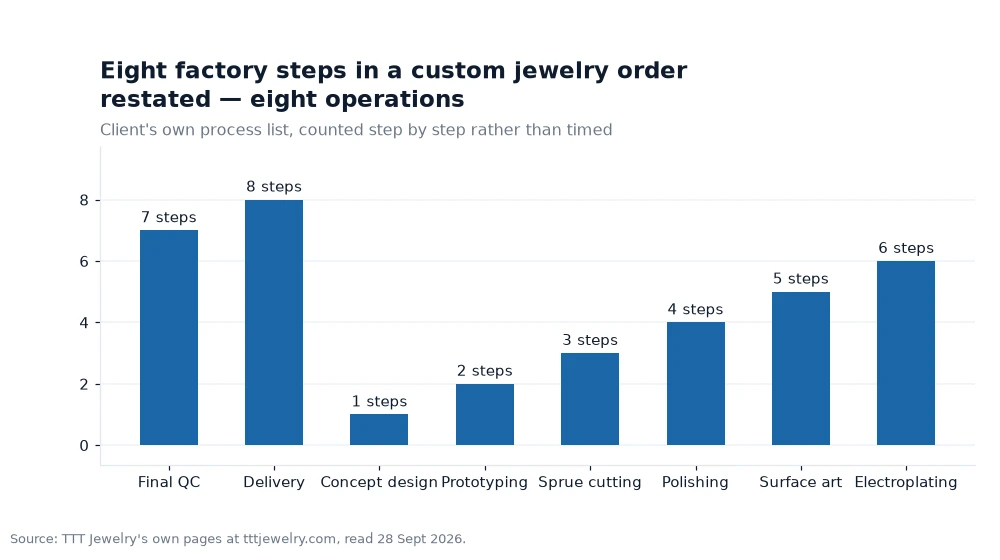
The published process list runs concept design, prototyping, sprue cutting, polishing, surface art, electroplating, final QC and delivery. Three of those eight — sprue cutting, polishing and surface art — happen in sequence on the same bench, which is why a cosmetic change late in the process is not free.
Final QC is the second-to-last published step and it covers 100% of the pieces. Delivery follows inspection, with branded packaging and express shipping, and the customs paperwork travels with the order.
What the buyer controls on the schedule
Two gates belong to the buyer: CAD approval and sample feedback. Both should have a named owner before the order is placed, because neither is included in the published windows. A week lost at CAD approval pushes the sampling window a week, and the production window behind it does not compress to absorb the loss.
The published support model is built for that rhythm: a 24-hour response window and a 1-on-1 dedicated project manager. Used well, those two commitments turn a scheduling question into a message rather than a guessing game.
The silver line publishes four details that belong in the purchase order: every piece stamped S925, a nickel-free and allergy-free alloy, eco-friendly electroplating on a 925 base, and a compliance block with ISO 9001:2015, BSCI and REACH. Sample testing before production is the fourth checkpoint on the schedule, and it is the one that decides whether the batch behind it goes ahead.
Quoting an order before you commit
Send the design references, the metal, the finish, the quantity per design and the target date in one message. The floors are 100 pieces in eco-brass, 100+ pcs in stainless steel and 50 pcs in 925 sterling silver, per design, applied design by design.
Ask for the three windows back in writing, and note the turnaround time on that reply. A factory that answers within the published 24 hours has demonstrated the response commitment before the order exists, which is a better signal than any brochure.
| Stage | Published window | Owned by |
|---|---|---|
| 3D CAD modelling | Under 48 hours | Factory, then buyer approval |
| Master physical sampling | 25–30 days | Factory, then buyer feedback |
| Mass production | 3–4 weeks | Factory, after sample sign-off |
| Final QC and delivery | 100% inspected, express shipping | Factory |
| Enquiry response | 24 hours | Factory |
Worked example: a lead time you can put in a contract
Convert the three published windows to days and add them. CAD is 48 hours, which is 2 days. Sampling is 25 to 30 days. Production is 21 to 28 days. The total is 2 + 25 + 21 = 48 days at the fast end and 2 + 30 + 28 = 60 days at the slow end, which is about seven to nine weeks.
Now count the eight steps against that calendar. Eight operations across 48–60 days is 48 ÷ 8 = 6 to 60 ÷ 8 = 7.5 days per step on average, but the published windows are not evenly spread: CAD is a fraction of a day of work and sampling contains five of the operations. The honest reading is that the average is meaningless and the window figures are the only ones worth planning from. The sums are mine; the windows are the manufacturer's.
Compressing a lead time without cutting corners
The only legitimate compression is on the buyer's side and in the brief. A complete brief — metal, finish, quantity, packaging, hallmark placement — removes the clarification round that otherwise sits between enquiry and CAD. Approving a drawing on day one rather than day five saves four days for free.
The other saving is combining designs., so a two-design package lands at twice the published number4 week block is paid once rather than twice. Anything that promises to shorten the 25–30 day sampling window by half is not shortening the process, it is skipping an operation.
Where the lead time is actually lost
Compare a planned 48–60 day schedule with the date a first order actually lands and the missing fortnight is rarely at the bench. It is lost in three places: an enquiry that arrives without a metal or a quantity, a drawing that waits for sign-off, and feedback on a sample that comes back in pieces over two weeks.
A buyer can request quote data for two materials in one message instead of sequencing the questions, which removes a week of back-and-forth from the front of the schedule.
The other habit worth building is a two-day rule on the drawing. Forty-eight hours is the published CAD turnaround, and if approval comes back in the same time, the sampling window starts on day four rather than day eleven.
Frequently asked questions
Can production start before the sample is approved?
No. Bulk production follows sample approval in the published workflow, which is why the 25–30 day sampling window sits in front of the 3–4 week production window on every plan.
What happens if the CAD drawing needs a revision?
The drawing stage is quoted at under 48 hours and revisions stay inside it, which is why settling stone sizes, thickness and finish on the first pass protects the sampling date behind it.
How long does shipping add to the lead time?
Shipping is not part of the published windows. The three quoted stages are CAD, sampling and production; the delivery step covers branded packing, express shipping and customs support, and the transit time depends on the destination.
Asking for the schedule in writing
The three windows are the whole lead-time story, and they are short enough to fit in a single email. Ask for them once, confirm them in the purchase order, and keep the buyer-side gates on your own calendar where they can be managed.
Where a range needs more than one material, the schedule changes with the minimum rather than with the process: the eco-brass line starts at 100 pieces per design and the silver line at 50, so the, with the figure repeating design by design. The OEM and ODM routes are also worth reading before the brief is written, since the route decides who owns the drawing.
Where the numbers come from — the eco-friendly electroplating with the ISO 9001:2015, BSCI and REACH certifications plus the S925 hallmark on every piece — is the brand's own pages at the tttjewelry.com address on 28 Sept 2026. The day-and-week bookkeeping is mine, not the site's[1].