
Premium Fragrance Manufacturing: What an Established Beauty Brand Gets Wrong
An established beauty brand moving into premium fragrance rarely fails because the factory cannot fill a bottle. It fails because assumptions carried over from mass personal care quietly stop being true: sampling tolerance narrows, documentation expands, decoration becomes a specification, and the cost of a late change multiplies. The mistakes below account for most of the damage, and every one of them is avoidable before tooling is cut.
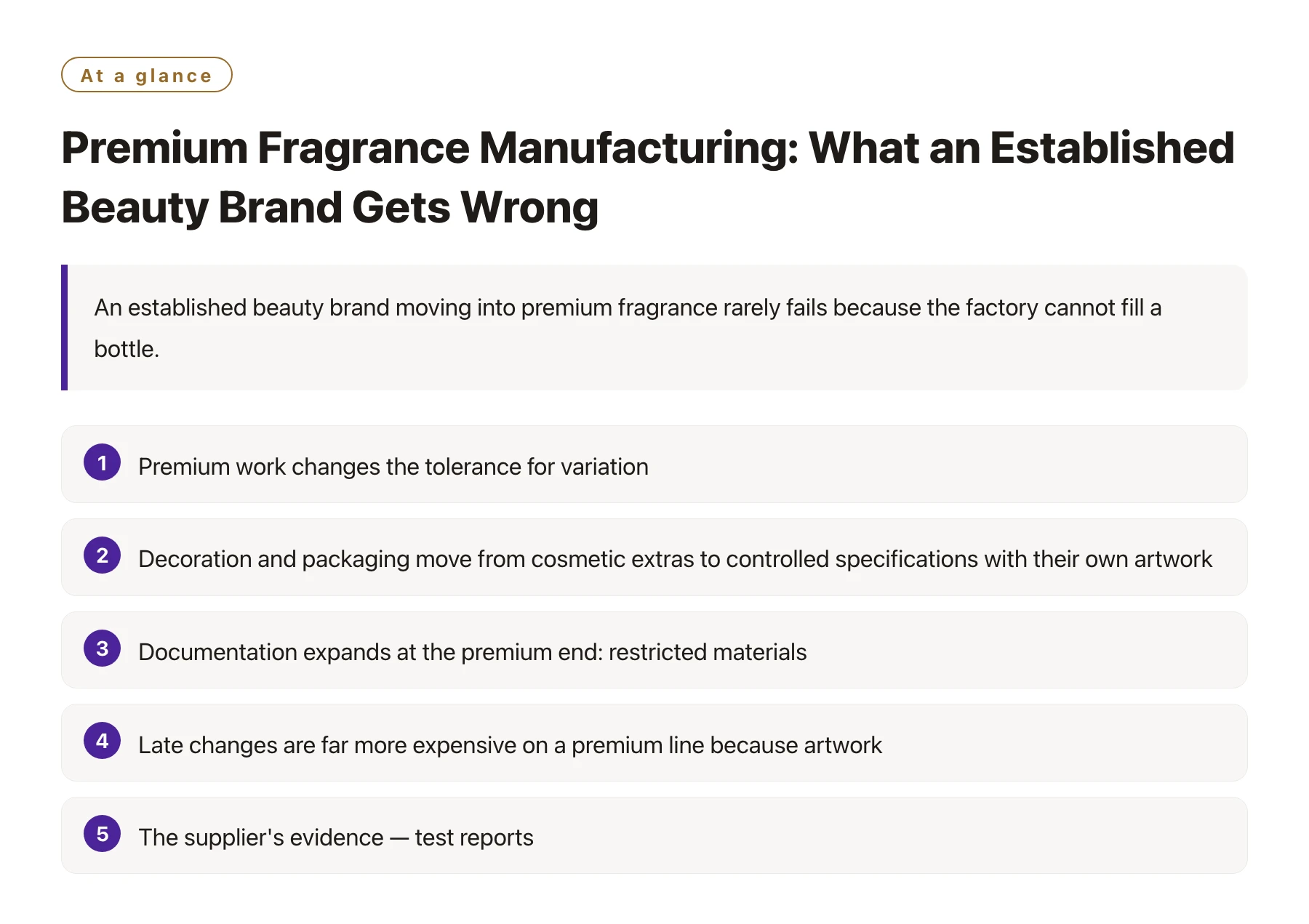
Key takeaways
- Premium work changes the tolerance for variation, not just the price, so the acceptance criteria have to be written before sampling.
- Decoration and packaging move from cosmetic extras to controlled specifications with their own artwork, tooling and inspection points.
- Documentation expands at the premium end: restricted materials, safety assessment and batch records become part of what the buyer must hold.
- Late changes are far more expensive on a premium line because artwork, tooling and approval cycles are longer and less forgiving.
- The supplier's evidence — test reports, batch records, inspection criteria — matters more than its showroom when the product leaves the factory.
A beauty brand that already manufactures creams, serums or body care has real advantages when it adds a fragrance: it understands cosmetics regulation, it has a quality team, and it knows how to run a packaging project. What it usually lacks is a feel for where the premium tier tightens.
That gap shows up as a series of small decisions that each look reasonable and collectively raise cost, delay the launch and weaken the product. None of them is dramatic on its own. Together they are the difference between a line that reads as premium and one that reads as an expensive version of a mass product.
The perspective here is a brand that is already established — not a founder starting from nothing — and the mistakes are specifically the ones that experience in mass personal care makes more likely, not less.
What actually changes when a line goes premium
The material cost of a premium fragrance is higher, but that is the least interesting difference. The real change is in variation. A mass body care product tolerates a certain drift in colour, viscosity or scent intensity. A premium fragrance is compared side by side with an approved reference, sometimes months after approval, and a small drift that would pass unnoticed elsewhere becomes a complaint.
The second change is the paper trail. Premium buyers, distributors and retailers expect the brand to be able to produce documentation on demand: what is in the formula, which materials carry restrictions, how the product was assessed for safety, and what the batch record shows. Third-party testing and inspection services exist precisely because that evidence has to be produced by someone credible [3].
Restricted materials set the ceiling earlier
Fragrance materials are not free to use at any concentration. The standards maintained by the fragrance industry restrict how much of a given material may appear in a product category, and those limits sit in the background of every formula [1]. On a flagship premium scent with a higher oil load, more of each allowance is used up, so reformulation risk arrives sooner than it does on a light body spray.
Cosmetic rules follow the product, not the price
A premium fragrance is still a cosmetic product. The safety assessment, the ingredient list and the allergen declarations follow the finished formula, which is why a change late in the project can reopen work that everyone believed was closed [2]. Industry bodies that represent the cosmetics sector publish guidance on these obligations, and reading it before the brief is written is cheaper than reading it after the sample is approved [4].
Assumptions that stop being true
| Assumption from mass production | What premium changes | What to do instead |
|---|---|---|
| A small colour or scent drift is acceptable | Samples are compared against a reference months later, so drift becomes visible | Write numeric acceptance criteria and a reference retention procedure into the specification |
| Packaging is bought once and approved visually | Decoration, print and finish carry their own tooling, tolerances and inspection points | Treat decoration as a controlled process with its own approved sample and inspection criteria |
| The quality team can catch issues at final inspection | Premium work is decided at incoming materials, compounding and filling, not at the end | Agree inspection gates with the supplier and ask for records at each gate, not a final certificate |
| Documentation can be assembled at the end | Restricted-material limits, safety assessment and batch records are needed before shipping | Build a document pack checklist at the brief stage and assign an owner for each item |
| Changes can be absorbed during the run | A late change reopens artwork, tooling, testing and sometimes the safety assessment | Freeze the specification before tooling and route all changes through one approval owner |
Read the middle column as the actual work of going premium. None of it is technically difficult; all of it requires deciding in advance instead of deciding under pressure.
Five mistakes that cost the most
These are the errors that appear most often when an experienced beauty team runs its first premium fragrance project. They are listed in rough order of how expensive they are to correct.
Approving a sample without written acceptance criteria
If the approved sample exists only as a bottle in a drawer, then every later comparison is an opinion. Record what was approved: fill volume, colour, clarity, scent against a retained reference, spray performance, crimp and finish. A signed reference sheet turns a future argument into a measurement.
Treating decoration as a purchasing decision
Coating, printing, hot stamping, frosting or metallising each behave differently at volume and each interacts with the base material. A premium finish that looked perfect on ten pieces can show hazing, misregistration or wear on ten thousand. Approve the process, not just the look, and inspect it at volume.
Choosing the supplier on the showroom
A premium presentation is not evidence of premium control. Ask to see the deviation process, a recent batch record, the calibration schedule for measuring equipment and the list of tests run on every batch. A supplier that cannot produce these documents is not a premium supplier, whatever its reception area looks like.
Leaving fragrance and packaging in different hands without an owner
When the juice comes from one supplier and the bottle from another, someone has to own compatibility: how the formula behaves with the chosen liner, pump and seal, and how the scent reads after time in that pack. Without a named owner, compatibility is discovered at the customer rather than in the lab.
Underestimating the approval calendar
Premium projects carry more approvals, not fewer: internal stakeholders, retail buyers, sometimes a licensing partner. Each one adds a round of comments and a possible rework. Build the calendar backwards from the shelf date and add slack at the approval stages, which is where premium launches most often lose weeks.
The premium mistake that hides best is scaling up a formula that was never tested in the chosen pack. A scent that performs beautifully in a glass vial can read differently in a coated bottle with a different pump and a different headspace. Before the bulk order, ask for an aged sample in the production pack. It costs one round and prevents the most expensive outcome in premium fragrance: a beautiful product that arrives smelling not quite like the one that was approved.
How to test a supplier before committing premium volume
Start with the questions that require evidence rather than opinion. What are the acceptance criteria for a fragrance batch, who signs the reference sample, how is it stored, and how long is it kept? How are restricted materials tracked through formulation, and who confirms the limits before compounding? What happens when a batch deviates — what is the disposition process and who decides?
Then ask to see the parts of the operation that premium work depends on: the weighing and compounding area, the filling and crimping line, and the inspection point where finished units are checked. A walkthrough such as a visit to Xuelei's factory should be a working session, not a tour, and you should leave with documents rather than impressions.
Ask too about the supplier's own background. Certifications tell you which management systems are in place, but the audit history behind them, the age of the quality function and the depth of the development bench tell you whether those systems are exercised daily. A supplier that frames this openly as its background and certifications is easier to assess than one that leads with a certificate count.
For the premium end specifically, ask how quality control is organised across the run. A programme described as quality control in luxury fragrance production should name the gates, the records kept at each one and the person accountable. If the answer is a list of adjectives rather than a sequence, that is your signal.
Finally, test the development side of the house, not only the production side. A supplier that can take a brief through formulation and also keep the product consistent at volume is effectively offering custom fragrance R&D and production under one roof, which removes the compatibility problem described above. Ask how the development team hands a formula to production and who signs that handover.
Run a small premium pilot first
Before a flagship order, place a small pilot in the final packaging, on the final filling line, with the final artwork. The pilot's job is not to sell; it is to expose the interactions that specification documents miss. Treat it as paid research and judge the supplier on how it handles what the pilot reveals.
Sources
- IFRA Standards Library (International Fragrance Association) —— The IFRA Standards Library lists the restrictions the fragrance industry applies to individual fragrance ingredients, based on safety assessments; it is the reference point for compliant fragrance formulation.
- EU Scientific Committee on Consumer Safety (SCCS) —— The EU scientific committee that issues opinions on the safety of cosmetic ingredients, including fragrance allergens and their labelling thresholds.
- SGS: Cosmetics, Personal Care & Household Testing —— Testing, inspection and certification services for cosmetics and personal care, including microbiological, stability and safety testing aligned with cosmetics GMP.
- Cosmetics Europe —— The European trade association for the cosmetics and personal care industry, publishing guidance, positions and market information.
Frequently asked questions
What makes premium fragrance manufacturing different from standard production?
Tighter tolerance on variation, more controlled decoration and packaging processes, a longer approval calendar and a heavier documentation burden covering restricted materials, safety assessment and batch records. The filling technology is broadly similar; the discipline around it is not.
Do I need different documentation for a premium fragrance line?
Usually the same categories of document, held to a stricter standard. Expect restricted-material confirmation, a safety assessment, an approved reference sample record, batch records and inspection criteria for decoration. Confirm the local requirements for each market you sell into.
Why do premium projects go over schedule so often?
Because approvals multiply. Internal stakeholders, retail partners and sometimes licensors each add a round of comments, and a comment on artwork or finish can send tooling back. Build slack around approvals rather than around production.
Should the fragrance and the bottle come from the same supplier?
Not necessarily, but someone must own compatibility — how the formula behaves with the chosen liner, pump and seal, and how the scent reads after time in that pack. If nobody owns it, the interaction is discovered by the customer instead of in the lab.
How do I judge a supplier's quality control before ordering?
Ask for evidence rather than assurances: acceptance criteria, a recent batch record, equipment calibration, the deviation process and the named owner of each quality gate. A supplier that answers in sequence is showing you a system; one that answers in adjectives is showing you a sales pitch.
Ready to make your UI move? Ship cinematic motion at 144fps, bundles under 18KB.